
2015 Honda Fit Is Roomier, Stronger, Fun to Drive
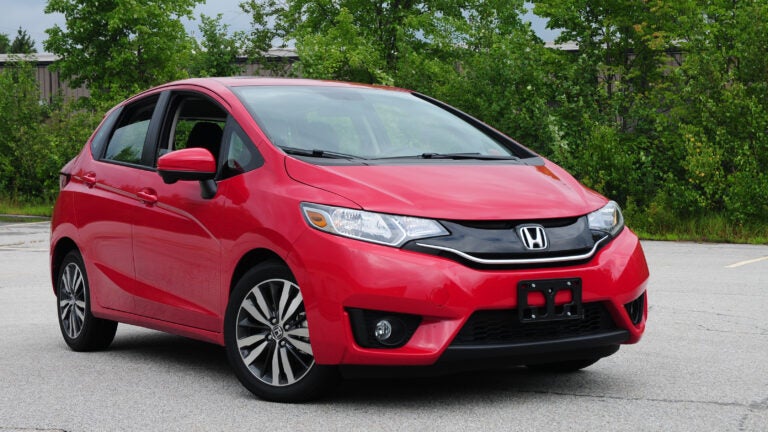
My mother used to ask what car I was driving each week for review. During those weekly calls, she provided proof that brand awareness does create brand recognition. She wanted to know colors, if one had spoilers or driving lights—things the mother of a car reviewer likes to know.
I thought of Mom while driving the 2015 Honda Fit around New Hampshire. There seem to be a great variety of Fit models and add-ons, some that have been with us since the car appeared in 2006.
Since its debut, this now third generation Honda, is, in a word, more fit. The 2015 is roomier, stronger with the use of more high-strength steel, more efficient, and more versatile.
Shaped in a wind-cheating wedge to slip through the air, this Fit is a four-door hatch that purports to seat five (if they measure the rear seat in “Smoots,’’ aka the fellow used to “measure’’ the Harvard Bridge, it’s a go). They’ve created additional interior room with a so-called Magic Seat.
Seat cushions and seat backs have flipped for years to increase space for your stuff. Now Honda has moved the gas tank under the car’s front seat so when the rear seat cushions flip up, there’s more room below the standard floor to hold larger, taller items. If you covet that large fake plant at Pottery Barn, it’ll fit into your Fit.
The fitter Honda Fit is an engineering nerd’s dream. It’s 1.6 inches shorter than last year’s iteration; however, the rear seat has been pushed backwards nearly 5 inches, there’s 4.9 more cubic feet in passenger volume, 11 percent more peak horsepower (it now has 130 hp), and a 7.5 percent peak torque boost to 114 lb.-ft.
All that backseat maneuvering means riding along isn’t an assignment to steerage. Nor will your passengers pull out their Knee-Defender, the one that can stop an airplane seat from reclining and crushing your knee caps. You’ll find the floor space under the front seat—read that again, slowly—angles up a bit,creating something akin to a limousine footrestin a subcompact car.
Trade-offs mean compromising, so the interior rear seat room encroaches upon the, ahem, cargo room of this compact car. There’s not much—remember what size car this is; its primary mission is fuel efficiency not carpooling or pulling an Air Stream.
Upfront, there’s plenty of room and no cause for claustrophobia. The controls are not unlike any other Honda, providing muscle memory intuitiveness. In an effort to embrace connectivity, Honda uses a seven-inch touch pad screen for audio interaction that fails to deliver. If one shouldn’t text and drive, neither should one move his head to see which way he just swiped his oily finger on a touchpad at highway speed.
Power is up in the 1.5-liter DOHC (dual-overhead camshaft), 16-valve, 4-cylinder, to 130 hp, the same output offered in the old Neons considered outstanding at the time, and it pulls the front-driver around nicely. Mated to a 6-speed manual transmission, the tach usually hovered in the 3,000 rpm range at 65 mph, causing us to want another gear to get into overdrive or prove that the last shift was not missed. While you may not pass many cars in the Fit, you’ll smile when you pass gas stations with its fuel efficiency.
We did hit the EPA numbers posted on the sticker regularly. On one tank, I managed 41.22 mpgs. Overall, with 566.8 miles of mixed driving and without the green “eco’’ button depressed, I averaged 39 mpgs. Honda predicts your annual fuel cost at $1,650 based upon 15,000 miles per year at a cost of $3.50 per gallon.
The ride benefits from front struts, a rear torsion beam suspension, and rack-and-pinion steering that makes the ride effortless, more absorbing of rough road than other comparable econo cars. Decent seat support and plenty of glass all around augment the rear-view camera; Honda’s right-side camera shows what is or isn’t in your blind spot.
Getting an economy car used to mean that you sacrificed comforts, mainly to one’s skeleton and neuromuscular system in the name of extra mpgs and a smaller monthly payment.
The Fit is no longer a trade-off car. It now has the toys that the big boys like in a snazzy compact package that won’t leave you apologizing for your finances like that time you bought a Ford Pinto.
If the jumbo shrimp oxymoron makes sense to you, you’ll love the paradox of how big the subcompact Fit is.
2015 Honda Fit EX
THE BASICS
Price, base (with destination): $17,435 ($790); as tested: $18,225. Fuel economy: 29mpg city/37mpg highway. Drivetrain: 1.5-liter, 4-cylinder engine. Body: Four-door hatchback.
THE SPECIFICS
Horsepower: 130 hp @ 6,600 rpm. Torque: 114 lb.-ft. @ 4,600 rpm. Overall length: 160.0 in.Wheelbase: 99.6 in. Height: 60.0 in. Width: 67.0 ins.Curb weight: 2,573lbs.
THE GOOD
Fun to drive. Fuel economy. Roomier than it looks.
THE BAD
Audio touch screen hard to use. Slow acceleration.
THE BOTTOM LINE
A subcompact car that has the same toys as the big boys at a fraction of the price and that passes up the gas pumps.
ALSO CONSIDER
Toyota Yaris, Hyundai Accent, Ford Fiesta, Mazda 2.



To comment, please create a screen name in your profile
To comment, please verify your email address
Conversation
This discussion has ended. Please join elsewhere on Boston.com