
Hyundai’s Fuel-Cell Tucson: A Next-Generation EV
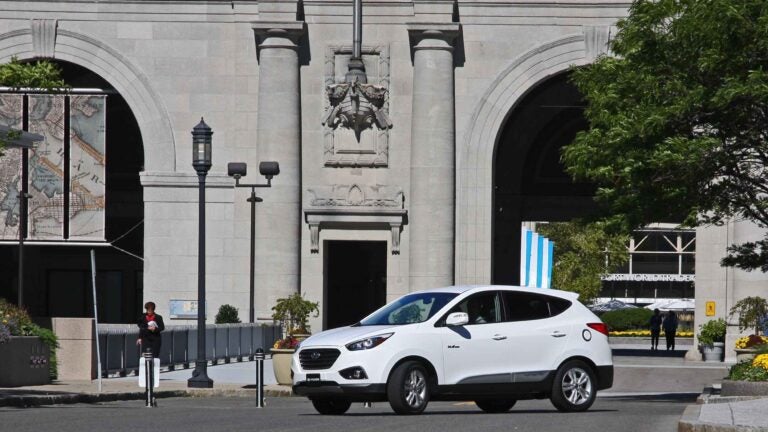
We went cruising up A Street, crossed over to D Street, and pretended that Southie was our home town Monday afternoon as we drove one of Hyundai’s fuel cell-powered Tucson SUVs through Boston’s streets.
The compact SUV rode and handled virtually the same as a Tucson powered by one of Hyundai’s conventional gasoline engines. If someone handed you the keys, you could drive away and not realize you were at the controls of the latest generation in electric vehicles.
However, you’d soon notice several features.
1.It was library-quiet inside, making it easy to converse with our rear-seat passenger. There was no engine or exhaust noise and minimal road noise.
2.The electric motor provided instant and smooth acceleration. There were no gear changes because there’s no conventional transmission, just plenty of torque and a smooth power curve.
3.A power-usage charging-gauge takes the place of a tachometer. The remaining driving range is prominently displayed. The Tucson is rated for a 267-mile range, a figure that can be exceeded by careful driving and use of the regenerative braking system.
Hyundai has the fuel cell vehicle on an East Coast tour to introduce it to politicians and key government decision-makers.
A week ago Tuesday, the Tucson was in Washington, DC, to show the country’s first mass-produced fuel cell vehicle to members of Congress and the Department of Energy.
Monday, it was in Boston where the Seaport Hotel, a venue with green initiatives and electric vehicle charging stations, was an appropriate host.
Charles Myers, president of the Massachusetts Hydrogen Coalition, and Stephen Russell of the state department of energy resources got a briefing and ride-and-drive in the fuel cell vehicle.
These visits are key steps in establishing the hydrogen refueling infrastructure that is part of the chicken-or-egg dance that will be necessary for the coming fuel cell vehicles to gain public acceptance.
A big company or government agency can integrate these vehicles into their fleets by having proprietary refueling stations.
Hyundai has been selling the Tucson Fuel Cell CUV at three Southern California dealerships since June, putting the cars on the road as the area gradually expands its refueling stations from 20 to 50.
A promising sign for the East Coast is that Rep. John Larson (D-CT) is a founder and co-chair of the House Hydrogen and Fuel Cell Coalition and has led efforts to increase hydrogen energy technology through infrastructure and investment tax credits.
“Fuel cells and hydrogen energy are a key to utilizing cleaner, domestic energy sources. From ending our dependence on foreign oil, reducing harmful emissions, and spurring American manufacturing, fuel cells will play a critical role in solving some of our most pressing problems,’’ says Larson.
Unlike battery-powered EVs, which need lengthy recharging, the hydrogen tanks in a fuel cell vehicle can be “gassed-up’’ in a few minutes, a process similar to refilling the propane tank for your gas grille.
What’s different is that the hydrogen is highly pressurized (10,000 psi). In the Tucson, it is stored in a pair of stainless steel tanks that are protectively wrapped in three inches of carbon fiber filament and have additional protective underbody covering. They hold 5.5 kilograms (12.4 pounds) of hydrogen.
The batteries and fuel tanks don’t noticeably reduce passenger or cargo space.
The Tucson has a pair of batteries—a conventional 12-volt for starting and normal accessories and a 24-kilowatt to provide additional power to the electric motor as needed.
“It’s a bit easier to fit everything into a small SUV like this than in a sedan,’’ says Hyundai’s Joe Guy Collier.
The EPA rates the Tucson fuel cell at the electric equivalent of 48 miles per gallon in city driving, 50 on the highway, and 49 combined. The fuel cell is more efficient than the internal combustion engine, which loses much of its power via heat.
Power numbers in the Tucson are 134 horsepower and 221 lb.-ft. of torque.
During the initial rollout, the fuel cell Tucson is being offered in Southern California only as a 36-month lease at $499 per month with $2,999 down. The price includes an unusual benefit, unlimited free hydrogen refueling.
While the fuel stack has no moving parts—it works by chemical reaction—the platinum that is the catalyst will degrade over time. Hyundai officials say that the fuel cell’s life expectancy will be at least 11 years or 150,000 miles to make it competitive with internal combustion engines for consumers.
The fuel cell vehicle has zero harmful emissions, releasing just water vapor as a byproduct of turning hydrogen into electricity.
Fuel cell maintenance consists of periodically replacing air filters and coolants instead of oil changes.
At the Seaport Hotel, a row of prime parking spots in the garage is reserved for charging EVs. On this day, a Tesla was plugged in at one slot.
It brought up the argument of whether consumers will prefer a plug-in EV such as the Tesla and Nissan Leaf or a fuel cell vehicle.
Plug-in advocates like the feature of being able to recharge at home overnight; fuel cell partisans say that refueling will be similar to gasoline stations once an infrastructure is established.



To comment, please create a screen name in your profile
To comment, please verify your email address
Conversation
This discussion has ended. Please join elsewhere on Boston.com