
VW e-Golf Combines Electric Lifestyle with Driving Comfort
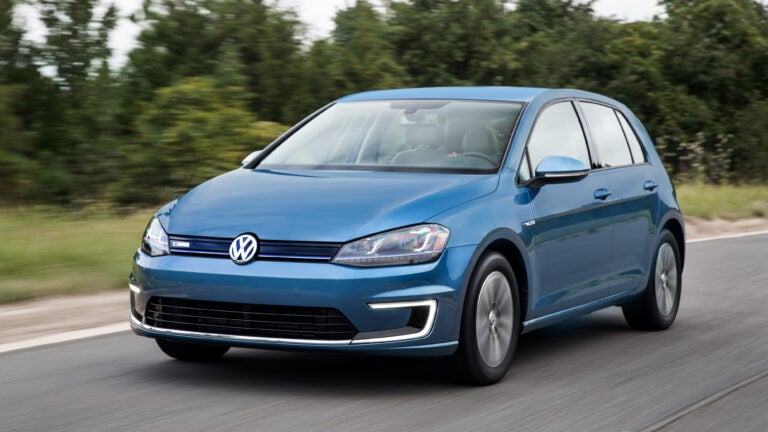
The electric vehicle market continues to grow more crowded in the US. Volkswagen is muscling its way into the competition with the 2015 e-Golf, and it’s going to stand a fighting chance on two fronts: price and drivability.
On the former, VW has announced that when the e-Golf hits dealerships in November, it will have a lease price of $299 per month. You can also buy this four-door hatchback for an MSRP of $35,445 plus $820 destination. That price includes navigation and leather, among other features.
You need to decide whether lease or purchase makes more sense for you. If you like to be the first on your block to own something—but don’t want it for more than three years —leasing is attractive.
However, if you like owning your car and getting the federal tax credits, the purchase option might get you charged up. There is a $7,500 federal tax credit.
But let’s focus on drivability. There is one discernible difference between the internal combustion Golf and its electric sibling: regenerative braking. Take your foot off the gas and the e-Golf instantly slows down. There is no coasting because the e-Golf is capturing the expended energy and converting it into power.
Speaking of regenerative braking—and you must when discussing electric vehicles or hybrids—the braking system can also be used to help manage the e-Golf range (more on that later). There are three driver-selectable levels available: D1, D2, and D3/B. By helping to control the amount of energy that can be recuperated from braking, the e-Golf can achieve additional driving range, according to VW press materials.
If the battery is fully charged and the vehicle is in standard D mode, no regenerative braking will occur. If you lift off the accelerator pedal or tap the shift lever to the left, the first level of regenerative braking, D1, is activated, with a small amount of energy recuperated (and the car slowed slightly). Levels D2 and the maximum D3/B offer increasing levels of energy regeneration.
OK, so lets look at range. Volkswagen estimates real-world driving numbers of 70 to 90 miles when the battery is fully charged. Top speed is electronically limited to 87 mph. Three driving modes—Normal, Eco and Eco+—prioritize performance or efficiency. Eco extends range, while Eco+ conserves energy by limiting the motor to 74 hp and a top speed of 56 mph.
The eGolf Drivetrain consists of 24.2 kWh lithium-ion battery and an electric motor with 199 pound-feet of torque in normal driving mode. It is rated at 115 horsepower.
Frankly, you should only use Eco after merging onto a highway and settling into the far-right lane where you can cruise along at 65 mph (or slower). It’s well suited to city, suburban, and rural driving as I experienced piloting the e-Golf on separate occasions in San Francisco and Middleburg, Virginia.
In Eco+ mode, where top speed won’t exceed the electronically limited figure of 56 mph, the accelerator pedal response curve is flattened even further. In addition, the vehicle’s air conditioning is switched off to help maximize efficiency.
Regardless of the drive mode selected, however, once you step on the accelerator pedal, you’ll be rewarded by the maximum power and performance of the “Normal’’ mode. Eco+ could be a great choice for rush-hour traffic when temperatures are below 90 degrees.
Another strong drivability aspect of the e-Golf is its design. Its electric vehicle status, which requires more battery space, wasn’t an afterthought. It was designed from the beginning to be an EV, which means no loss of space. The trunk’s cargo space is rated at 22.8 cubic feet, which jumps to 52.7 cubic feet with the seats folded. That blows away vehicles like the Hyundai Sonata, which has 16.3 cubic feet of trunk space.
Interior comfort is high with the e-Golf, even for a 6’1’’ driver like me. It comfortably handles four adults (maybe not all my height). There’s nothing compact in feel about the eGolf. I’d rank it comparable to the Nissan Leaf and Ford Focus, probably its closest electric vehicle competitor, in terms of comfort and drivability.
Who’s going to want the eGolf? Well, as with any electric vehicle, it’s going to work well as a family secondary vehicle if you have range anxiety. Some folks just want to know they can drive 100 miles or more at any moment—though few rarely do. The VW e-Golf can recharge to 80 percent in 30 minutes at a fast-charging station.
Commuters will find this car perfect, especially carpoolers. Encourage your company to install a charging station and your commute effectively is free.
2015 Volkswagen e-Golf
THE BASICS
Price, base (with destination): $36,265 before $7,500 federal tax credit. Fuel economy: 105 mpg equivalent with 70-90 miles range estimated. Drivetrain: Electric motor with 24.2 kWh lithium-ion battery. Body: 4-door sedan.
THE SPECIFICS
Horsepower: 115. Torque: 199 lb.-ft. Overall length: 168.1 in. Wheelbase: 103.6 in. Height: 57.1 in. Width: 70.8 in.. Curb weight: 3,391 lbs.
THE GOOD
This car has to be praised for its fuel economy of 105 mpg equivalent. Plus, it drives and handles as well, if not better than, comparable compacts. It also gets a thumbs up for generous trunk space.
THE BAD
Some folks aren’t going to like the limited range of 70-90 miles. Also, there is the added expense of installing a charger, which can be offset by the $7,500 tax credit. Plus, a comparable internal combustion Golf costs about $9,000 less.
THE BOTTOM LINE
Volkswagen has combined outstanding fuel economy with comfort and drivability in the 2015 e-Golf.



To comment, please create a screen name in your profile
To comment, please verify your email address
Conversation
This discussion has ended. Please join elsewhere on Boston.com