
Hyundai’s Hydrogen-Powered Car Briefly Arrives in Boston
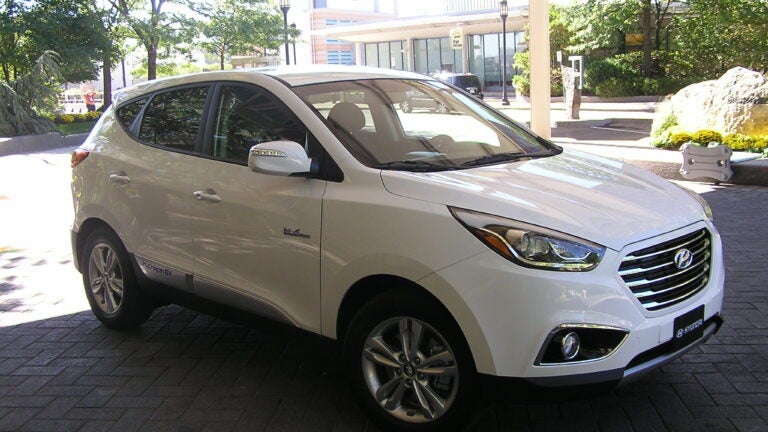
The 2015 Hyundai Tucson Fuel Cell Vehicle, a small SUV that runs entirely on hydrogen, made an appearance at the Boston Seaport Hotel on Monday afternoon.
It’s fitting that a vehicle like this parked in Boston so soon after this weekend’s worldwide protests demanding more action from world leaders address climate change. If the Tucson Fuel Cell is any indication, the message from environmentalists has been heard loud and clear.
There’s good news and bad news about the Tucson Fuel Cell’s Boston appearance. The good news is we got to take it for a test drive. The bad news is you probably won’t get the same chance anytime soon. But that’s part of the reason for the visit, said Hyundai Motor Group senior manager Bill MacLeod.
MacLeod said he wants to bring the Tucson Fuel Cell to the attention of policymakers in Massachusetts and in other New England states in order help grow the hydrogen car’s retail market. After all, there’s not much point in marketing a hydrogen-powered car in a region that has no hydrogen refueling stations.
“Hydrogen production isn’t the issue. The issues is making it available for mass distribution,’’ said MacLeod. “Fuel cell vehicle drivers currently have access to eight hydrogen stations marketing to California motorists and there are plans to open more.’’
MacLeod said he hopes to work with local policymakers on creating an “action plan’’ that will invite hydrogen-powered cars to hit road in the New England region.
As it currently stands, the Tucson Fuel Cell is only available to lease for customers in the Los Angeles and Orange County areas of California for $499 a month for 36 months with $2,999 down. The lease terms include free hydrogen refueling, said Hyundai spokesman Joe Guy Collier.
Collier walked me through the Tucson Fuel Cell during the test drive. It’s a very comfortable ride that almost feels, appropriately enough, like riding on air. The hydrogen power source allowed it to accelerate easily and offered a very quiet trip. When we took a wrong turn and almost ended up en route to Logan Airport, the car handled sudden lane shifts quite effectively. The only complaint is the brakes felt a little punchy.
The dashboard is an entirely different experience from a fuel-powered car. The car’s Driver Info Display shows a needle that rests on “Charge’’ while the car sits still, and moves to “Power’’ when it’s in motion. An electric panel tells you how much hydrogen fuel is left in the tank.
According to Collier, the Tucson Fuel Cell uses a fuel cell stack to convert hydrogen into electricity that powers a 100 kilowatt, 134 horsepower engine.
The engine allows the car to travel up to 265 miles on a full tank of 38 hydrogen gallons with fuel economy of 48 miles per gallon equivalent city and 50 miles per gallon highway equivalent.
The kicker: it produces no greenhouse gas emissions, emitting only water vapor.
One thing that really lets the Tucson Fuel Cell stand apart from other non-fuel vehicles like the Chevrolet Volt or the Nissan Leaf is that it can be refueled in roughly 10 minutes, compared to several hours for its all-electric competitors. It also outperforms by traveling further on a single tank and its hydrogen tank offers manufacturers a more flexible design.
What about safety? After all, driving around with a hydrogen tank strapped onto your vehicle might make some people nervous.
Hyundai Motor Group senior manager MacLeod said the hydrogen tank is made of aluminum and heavily protected by a three inches of carbon fiber filament. MacLeod also said the vehicle has also been certified by the US Department of Transportation and subjected to crash, fire, and leak tests with successful results.





To comment, please create a screen name in your profile
To comment, please verify your email address
Conversation
This discussion has ended. Please join elsewhere on Boston.com