
Next Sunday, Cars Take Over Boston Common
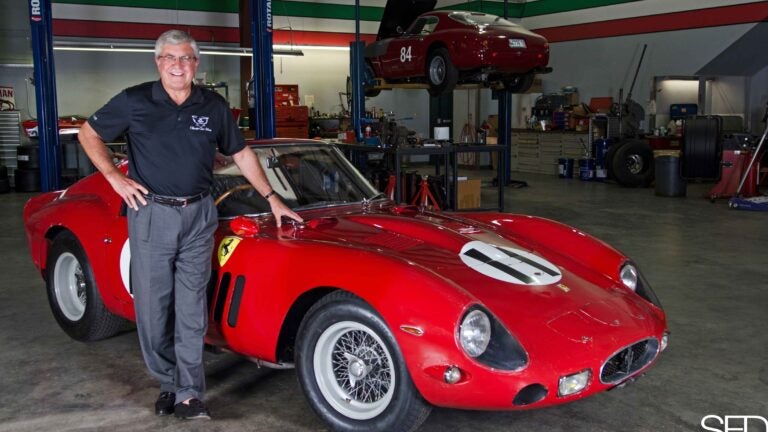
Rich Doucette had a vision: It was to put a first-class auto show on the Boston Common, displaying some of the world’s finest automobiles in America’s oldest park.
It took him seven years to get a permit for the first Boston Cup (in 2012).
Next Sunday, Sept. 21, the vintage vehicles will be in the city for a 3rd annual Boston Cup, surrounding the Parkman Bandstand from 9 a.m.-2 p.m. with displays of cars worth more than $100 million.
This year’s featured group will be classic race cars, headlined by a 1962 Ferrari 250 GTO, one of 36 produced to race for the Manufacturers World Championship for GT cars that year.
This particular Ferrari was delivered to Hall of Fame driver-owner Sir John Surtees and raced extensively in England, France, and Italy until early 1966, when present owners Jim and Sandra McNeil purchased the car for a relative pittance by today’s collector car standards.
Those who follow auction prices call this easily a $50 million car and say that, if it were put up for sale (it’s not) at the right venue, the sale price could approach $60 million.
The other hundred-plus cars on display next Sunday will be divided into six groups: American, Italian, British, German, Rest of Europe, and special display/electric vehicles.
It’s one thing to establish a car show, quite another to get a concours d’elegance such as the Boston Cup off the ground.
While next Sunday’s show will be all about the cars, today’s story is more about how they got there.
Boston Common unquestionably is a unique spot. It’s also out of the average entrepreneur’s league.
Doucette and his automotive enthusiast friends were crushed when the Trustees of Reservations ended the Castle Hill Concours following the 2002 show.
“When I attended the 2005 Museum of Fine Arts exhibition: ‘Speed, Style, and Beauty: Cars from the Ralph Lauren Collection,’ I was inspired to put together a show that is a combination of those two events,’’ says Doucette.
That’s why Boston had to be the venue.
Many friends joined in his crusade. They are successful people with motor oil lubricating their joints, and include Ed Owen, Emily Rooney, Tom Larsen, Ken and Brett Lemoine, Ed Casale, Gordon Owades, Peter Alcock, Tom Zarrella, and Bruce Ledoux.
“We probably wouldn’t have done it if we knew how much work it would be, but we wanted to pull it off,’’ says Doucette, who has the title of founding chairman. “Our core group is probably 50 volunteers. They choose the cars, do the website, lay out the field, and deal with the details that make a show work. That’s what has made this a concours. It’s become an elite show, but the last thing we want is to become hoity-toity.’’
Next Sunday’s show is free to the public, one of the ground rules for using the public park. You can expect 20,000 spectators to wander through the Common during the five-hour program. “It’s almost like an art exhibit,’’ says Doucette. “It’s both calming and inspiring.’’
The cars are behind the same steel fencing that’s used along the Boston Marathon course—a coincidence that doesn’t escape Doucette. “We want to make this an international event,’’ he says, “along the lines of both the Marathon and the July 4 fireworks.
“Two things differentiate us. We’re a low impact event. We start setting up at 7 a.m. and by 3 p.m. the objective is to have Boston Common looking like nothing had happened on the show day. Another is that we don’t interrupt normal city life.’’
The only folks inside the barriers are car owners, show sponsors, and those who want to pony up $75 for a VIP ticket or $50 for inside access.
“We’re not pushing those tickets,’’ says Doucette. “Those are for the few who have the need or desire to be inside.
“Our business model is different from a show that is dependent on admission fees. Our funding comes from solid sponsors and the money is there for us. It costs $100,000 to put on the show and we donate $25,000 to the city.’’
They say it takes five years to get a show fully established.
Doucette agrees. He’d love to find a major sponsor to embrace the event the way John Hancock has the Marathon and have a relationship such as Gillette does with the Patriots.
“It can grow,’’ says Doucette. “There’s more space on the common, plenty of hotel rooms, and easy access to public transportation. One signature sponsor with a vision can bring this to another level.’’
If there’s a hero in getting the event rolling, his name may be John Bailey, the director of special events for the Boston Parks and Recreation Department.
“Then-Mayor Menino and then-parks commissioner Antonia M. Pollak put it on his plate and let him make the decision,’’ says Doucette. “He took his kids to the Greenwich (Conn.) concours. He came back and said, ‘We can do this.’ ’’
And so they have.
Call it Vision Accomplished. And, if you can’t make it Sunday, circle Sept. 20 on that 2015 calendar you just bought. That’s next year’s date.


To comment, please create a screen name in your profile
To comment, please verify your email address
Conversation
This discussion has ended. Please join elsewhere on Boston.com