
How MIT, Industry Plan to Engineer Ever-Safer Drivers
Most of us know we could make ourselves better drivers if only we could concentrate harder, drive defensively, anticipate what other drivers are going to do, and eliminate distractions.
Meanwhile, the scientific community and the public sector are working together to make us safer drivers.
A panel of professionals will discuss the issue on May 29 at the MIT Media Lab when the New England Motor Press Association and MIT present the fourth of their annual panel discussions on leading-edge automotive issues.
Registration information can be found at http://conference.nempa.org.
Participants will be:
1) Brian Reimer, Ph.D., a research engineer at MIT’s AgeLab and associate director of the New England University Transportation Center. His work seeks to develop methodologies to measure and understand human behavior in dynamic environments such as behind the wheel. Some of his recent research has focused on how drivers can learn to understand and adapt to new vehicle technologies, getting accustomed to systems that differ from those in their previous vehicles.
2) John Bozella, the new president and CEO of Global Automakers, “the voice of automobile manufacturers since 1961.’’ The company represents the US divisions of 12 motor-vehicle manufacturers in working with industry, government and “other interested parties’’ in creating public policy that improves vehicle safety.
3) John Capp, director of electrical and control systems research at General Motors. His group is responsible for development of advanced electrical systems for safety, comfort, and infotainment. He’s also the strategic lead planner for active safety, driver assistance, and automated driving technologies.
4) Danny Shapiro is senior director of automotive, NVIDIA, focusing on faster and better design and in-vehicle solutions for infotainment, navigation, and driver assistance. NVIDIA developed the GPU, the engine of modern visual computing.
It’s an ever-changing world out there as technology:
• can sense a potential collision and enable a vehicle to take corrective braking and steering action automatically;
• soon will allow vehicle-to-vehicle and vehicle-to-infrastructure communications to change how traffic flows, reduce bottlenecks, and improve safety and fuel efficiency.
In addition, self-guiding autonomous vehicles are on the horizon. As a result, drivers are becoming less attentive than ever—while on-board infotainment provides ever more distractions. At the same time, the driving population is aging as Baby Boomers retire and Millennials put off driving altogether.
Panelists will discuss how we may adapt to these new safety and interface technologies, and the cognitive demands associated with them, and how the advances will impact car prices, safety, and insurance regulations.
The topic is timely for all drivers, but especially for older operators adapting to the new technologies.
According to a report by AAA’s Foundation for Traffic Safety, older Americans have an ever-increasing presence on the roads.
In 2010, 84 percent of Americans older than 65 held a driver’s license compared with barely half in the early 1970s. And they’re driving more often (a 20 percent increase in trips) and farther (a 33 percent increase in miles traveled between 1990 and 2009).
The Mille Miglia Spectacle
Almost every week there’s something going on that says to me, “This would be a good week to visit my family in Italy.’’
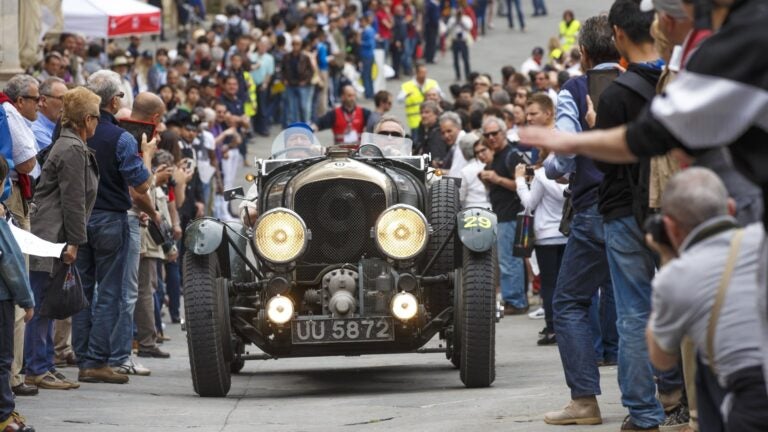
Today, it’s the final stage of the 2014 Mille Miglia, the annual four-day auto cruise from Brescia to Rome and back. This year’s 1,700-kilometer run began Thursday with the field finishing the last leg (Bologna to Brescia) today.
The Mille Miglia was contested 24 times as an open-road race from 1927-1957. Since 1977 it has been reborn as a vintage car cruising event.
One catch: It’s only open to the models of vehicles that ran in the original races. That means spectators get to see vehicles on the roadways that otherwise would be in museums.
Among the 400-plus entries are two of Bentley’s famous 4.5-liter supercharged “Blowers,’’ one a 1930 LeMans Team Car and the other an original Vanden Plas Open, Sports Four-Seater.
Both vehicles have successfully completed this modern Mille Miglia challenge several times.
For those of us who prefer to see classic cars driven instead of trailered to their destinations, this is one of the world’s great spectacles.
Honda Building F1 Engine
Honda has committed to returning to Formula One racing next year, where it will supply engines to the McLaren team.
Interestingly, Honda will be filling the void left when Mercedes ended its relationship with the McLaren team.
This year, the factory Mercedes team reportedly has developed a split turbocharger technology that is giving the cars of Lewis Hamilton and Nico Rosberg a significant power advantage.
New engine rules that went into effect for this season call for a 1.6-liter turbocharged V-6 engine with direct injection.
Honda has had a successful racing history; indeed, a Honda-powered car won last weekend’s inaugural IndyCar series race at the Indianapolis Motor Speedway, a kickoff to events leading to the 98th Indianapolis 500 on May 25.
The company has been away from Formula One for six seasons. Yasuhisa Arai, who is overseeing the engine development program, says that Formula One’s green initiatives and total energy management systems in the new power units “are both challenging and significant’’ in both the racing and producing applications for road cars.
Electric turbochargers are one racing technology that already is coming out of the Formula One engine programs.



To comment, please create a screen name in your profile
To comment, please verify your email address
Conversation
This discussion has ended. Please join elsewhere on Boston.com