
Car Tech: From Self-Cleaning Cars to Smart Roads
Have you heard of the new safety features that can alert you of a crash if you are not paying attention to the road? Such features are now becoming almost commonplace in the modern car market. Automakers once sold cars by offering features like leather seats and power windows, but when you can get those in an economy car, you have to look elsewhere for your value-adds.
In the case of new cars, technology equals luxury. The need for the latest tech means that luxury brands owned by larger automakers—those that have large tech budgets—have a distinct advantage in the car market of the future. Here are some of the leading features you will find in cars today and in the near future.
Seeing Two Ahead: For luxury automaker Infiniti, predicting a crash immediately in front of you was not enough. They sought to create a system that can tell if the car in front of you is about to experience a crash, allowing the driver even more time to react. This works by using the forward sensor, and actually bouncing it off the road underneath the car in front of you. We have seen it in action, and true to form, it allows the driver an extra several seconds to prepare for the car in front to slam on the brakes.
A Smart Rear-View: Infiniti, the premium division of Nissan, has plans for the future. Most notable is the Smart Rearview mirror. Nissan has replaced the conventional rearview mirror with a camera and an LCD screen embedded in a traditional mirror assembly. Once activated, the screen will give you the same perspective as before, but without the back seat passengers, head rests, or blind spots that get in the way. A widescreen mode can also be activated, but the system will have to wait for safety regulation to catch up with the new technology.
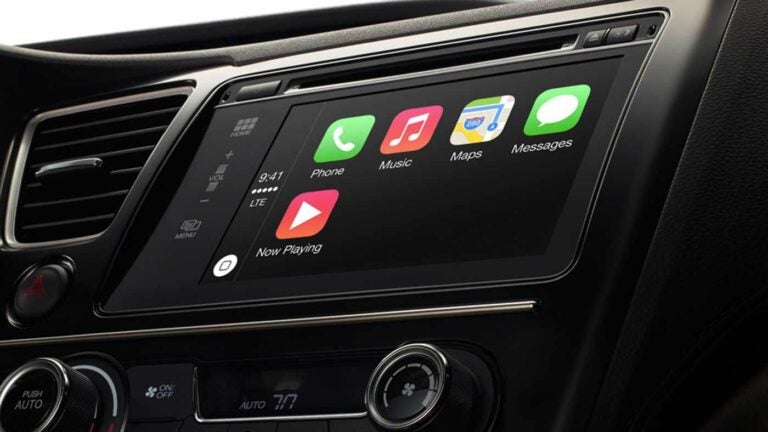
Apple’s CarPlay: Speaking of tech we’ve been waiting for, Apple has finally entered the in-car tech competition. More than anything, CarPlay is a means to operate your own iPhone’s functionality via a touchscreen interface. That includes the obvious ones like calling and playing music, but also the Maps app and texting (using text-to-speech and speed-to-text), as well as other future apps. CarPlay will first roll out in Ferrari, Volvo, and Mercedes-Benz vehicles, but will soon be joined by cars from Nissan, Jaguar, Land Rover, BMW, and General Motors. The system will also be available in aftermarket stereo head-units, allowing tech-savvy drivers on a budget to upgrade their older vehicle with very modern tech. You can bet Google will soon have an Android equivalent available for many applications.
Self-Cleaning Cars: The carwash industry is a lot larger than you might think. There are supposedly more than 15,000 carwash locations around the world, and that fact is predicated on the notion that cars get dirty and you don’t like your ride to look that way. But what if it didn’t have to look like that? Nissan recently applied a substance called Ultra-Ever Dry to one side of a European-market Note hatchback, known simply as the Note in the States. On the half that was sprayed with the new substance, water, dirt and mud simply beaded off the sides of the car. It looked like it had just left the carwash. This coating could one day be available in road cars, but likely as a paid option. Smart Roads: We’ve been talking about smarter cars, but what about smarter infrastructure? While we’re struggling just to keep up with ailing roads and bridges, various European countries are working on making roads smarter. In Sweden, Volvo is developing wireless, in-road charging systems for electric vehicles. A quarter-mile-long track has been built in cooperation with the Swedish Energy Agency, Swedish Transportation Administration, and several universities to develop this technology.
Meanwhile, in the Netherlands, a light absorbing paint has been put down along a short stretch of highway. This material is supposed to glow in the dark, allowing drivers to see traffic lanes no matter the conditions.
Technology will come along as fast as the R&D can be done, but does that progress always make things better? Are we ready for further iPhone integration? Do the more advanced safety features make us better drivers? Or does it make us lazy ones? The inability of safety regulators to keep up with the advancements in technology may not be intentional, but it serves a purpose; we want the newest and latest in our cars, but that might not be best for us. Despite the rapid advancements in technology, taking things slowly may be the best way to ensure that the marriage of man and machine in your daily driver is a successful one.




To comment, please create a screen name in your profile
To comment, please verify your email address
Conversation
This discussion has ended. Please join elsewhere on Boston.com