
Ford and MIT will drive special shuttles around Cambridge to study pedestrian traffic patterns
Boston.com Cars is your go-to resource for coverage of local car news, events, and reviews. In the market for a car or truck? Check out our new car specials and used car specials curated by our local dealer network.
Researchers from Ford and MIT are partnering to bring a special shuttle service to the MIT campus, with the aim of collecting data that will help build better models for predicting where and when on-demand ride services will be most needed.
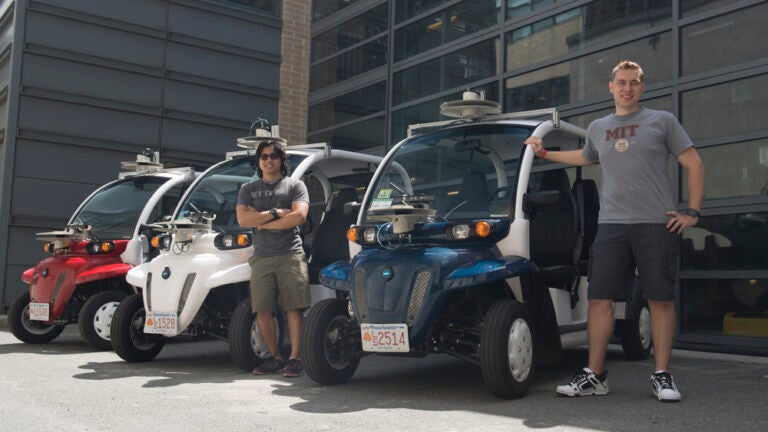
A fleet of on-demand electronic vehicles will occupy the MIT campus for the project’s duration. Starting in September, a select group of students and faculty will use a smartphone app to request trips around MIT’s Cambridge campus.
The vehicles can be driven on city streets, sidewalks and campus walkways. They’re not self-driving, but they are equipped with LiDAR sensors and cameras to gauge how pedestrians move and use that data to create a more effective shuttle route around campus.
They are also equipped with weatherproof enclosures that are meant to protect occupants from New England’s winters.
The goal is to use the data on pedestrian movement patterns to better predict where and when people will need rides and develop more effective routes. Researchers will also take into account other factors that can influence pedestrian movement on campus including class schedules, weather patterns and how students and faculty interact with the service during different semesters.
MIT will conduct the research through its Aeronautics and Astronautics Department’s Aerospace Controls Lab.
“Through the mobility-on-demand system being developed for MIT’s campus, ACL can investigate new planning and prediction algorithms in a complex, but controlled, environment, while simultaneously providing a testbed framework for researchers and a service to the MIT community,’’ said MIT professor and ACL director Jonathan How.
In a phone interview with Boston.com, How said once participants request a ride from point A to point B the system can tell them if a vehicle is available at the time of request, how long it will take to arrive, and allow the user to accept or reject the ride.
“The onboard sensors and cameras gather pedestrian data to estimate the flow of foot traffic,’’ said Ken Washington, vice president of Research and Advanced Engineering at Ford, in a statement. “This helps us develop efficient algorithms that bring together relevant data. It improves mobility-on-demand services, and aids ongoing pedestrian detection and mapping efforts for autonomous vehicle research.’’
In addition to helping efforts to build self-driving cars, How said the results of the project could have an implications on urban design and alter the future layout of cities and college campuses.
“It’s a small piece of a bigger puzzle,’’ he said.





To comment, please create a screen name in your profile
To comment, please verify your email address
Conversation
This discussion has ended. Please join elsewhere on Boston.com