
MIT Tech Review Thinks You Should Expect Vehicle-to-Vehicle Technology Soon
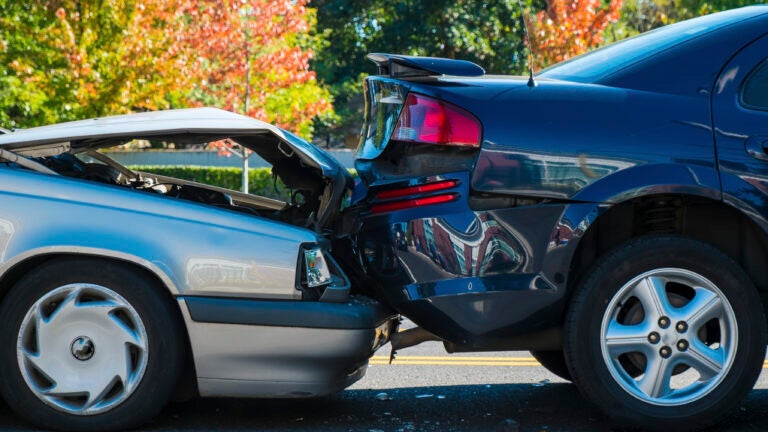
What if your car warned you seconds before an accident, giving you enough time to swerve or slam on the brakes — maybe even save your life? That is the promise of V2V technology.
The MIT Technological Review predicts car-to-car or vehicle-to-vehicle (V2V) communication will be one of the 10 breakthrough technologies of 2015. Carmakers like General Motors are busy testing V2V concepts and plan to put it in new models in the next two years.
The number of car crashes per year in the U.S. has been declining since 2006 (with the exception of 2012), but there were still 32,719 traffic deaths in 2013. Proponents of V2V think the technology can bring that number down.
A fully implemented V2V system would connect drivers travelling near each other, allowing a car to gather information on what other vehicles are doing even if a driver can’t see them.
“Let’s say you are driving on a highway, it’s busy and there’s a big semi ahead of you, but you can’t see what’s going on ahead of that truck,’’ Dan Flores, senior manager for General Motors communications, explained to Boston.com. “If your car had V2V and the car ahead of truck was enabled with V2V and the car in front of the truck slammed on its brakes, it would be communicating that information out. When the driver hits the brake hard that car is broadcasting what is going on. Your car will pick up frequency without you seeing he put breaks on really hard.’’
The system would rely on radio chips hat broadcast information about a car’s location, speed, steering wheel position and brake status many times a second, according to Edmunds.com.
Flores said chips can communicate within a quarter of a mile in all directions, much further than current “driver assist’’ sensors, which oftentimes only have sensors for cars you can physically see.
Flores mentioned that a problem with V2V is the limited number of cars that will be built with the technology. Widespread implementation of V2V chips is necessary for the system to work as planned.
“Until there are more vehicles that have this technology,’’ Flores said. “There won’t be other cars to talk to other than their own.’’
General Motors was the first auto manufacturer to announce it will produce a car, Cadillac’s 2017 GTS, with this technology, according to Flores.
Flores hopes GM’s jump into the V2V market will inspire other automakers to put the technology in their cars.
GM is among a number of manufacturers in the Crash Avoidance Metrics Partnership (CAMP), which is working with the National Highway Traffic Safety Administration (NHTSA) and the University of Michigan to create V2V technology and actually offer it in automobiles in the near future.
CAMP’s goal has been to create common standards and a common technology for automakers to use, Flores said. It is then up to the automaker to customize how it wants the information to notify drivers while they are driving of what other cars are communicating.
The MIT Technology Review thinks V2V networks are within closer reach than driverless cars, another technology promised to improved driver safety:
“Self-driving cars could eventually improve safety, they remain imperfect and unproven, with sensors and software too easily bamboozled by poor weather, unexpected obstacles or circumstances, or complex city driving. Simply networking cars together wirelessly is likely to have a far bigger and more immediate effect on road safety.’’
In fact, cars with V2V technology have been used in Ann Arbor, Michigan.
The University of Michigan Transportation Research Institute (UMTRI) started a Safety Model Pilot Deployment, a 12-month deployment, beginning in August 2012, of over 2,800 vehicles and created 25 infrastructure sites, such as intersections and light posts, with V2X technology. The operation functioned via V2X networks which include V2V, but also communicate with infrastructure and people.
Debra Bezzina, senior project manager for UMTRI, said the deployment of vehicles included trucks, buses, passenger vehicles, bicycles, and motorcycles.
Though the 12 month period is over, she said, UMTRI will keep the cars in operation in what is now called Early Operational Deployment, which is “more real world now.’’
Though the data analysis report from the UMTRI modeling project is still pending, she said, NHTSA announced it would eventually like to make V2V communication mandatory for all new vehicles.
“I can only imagine they found safety benefits,’’ Bezzina told Boston.com. “The technology is targeting about 82 percent of all collisions, so it will have a definite impact. [V2V] is almost one of those technologies like when we started getting seatbelts.’’



To comment, please create a screen name in your profile
To comment, please verify your email address
Conversation
This discussion has ended. Please join elsewhere on Boston.com