
US Transportation Department’s Bleak Study Resonates With Bostonians
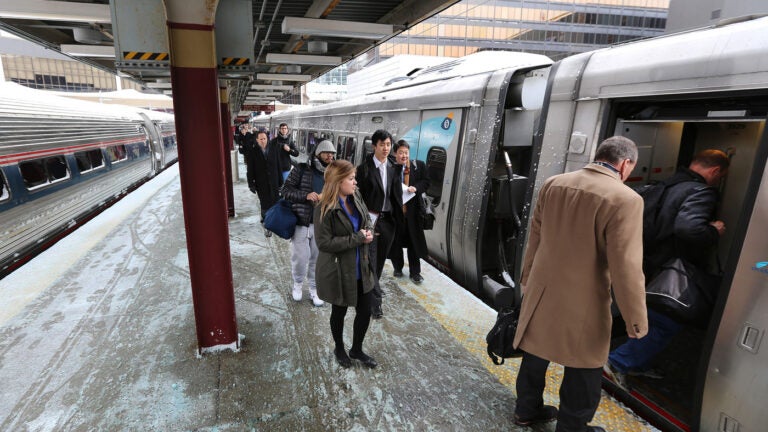
A study released by The United States Transportation Department last week made predictions for what America’s transportation systems would look like in 30 years, opening with a scenario in which a women tries to take the Long Island Rail Road to work: “The day before, the same train was already too full to board and bypassed her station. So did the next train. Now, the woman wonders not just when she will get to work, but if she will get there at all.’’
Sound familiar?
It’s no secret that Boston has had transportation issues lately. With a recent wave of winter storms dropping historic amounts of snow, the city has been scrambling – and failing – to prevent gridlocked traffic, limited MBTA service, and disabled trains.
The current transit mess eerily foreshadows some of the predictions in the DOT study, “Beyond Traffic,’’ which describes America’s transportation system in 2045 as “a fossil.’’ The study also predicts crumbling bridges, flooded airport runways, perpetually gridlocked roadways, and inefficient commuter trains.
The DOT’s bleak report also mirrors an ongoing study by Boston Transportation Department, called “Go Boston 2030,’’ which will imagine the future of transit in the city.
Though the plan is still in its beginning stages, Boston Transportation Department’s Director of Policy and Planning Vineet Gupta said he sees many parallels between the national DOT study and Boston’s.
“The trends in Boston mimic the national study,’’ Gupta said, citing similar maintenance concerns, climate change questions, and technological challenges. Boston’s study is what’s known as a “question campaign,’’ Gupta said.
On the city’s transportation department website, the public is encouraged to submit questions about the future of Boston transit. This will drive the agency’s research and planning, Gupta said.
“We’re undertaking getting residents and those who work in Boston to give us ideas for what their ideal situation for the future of Boston transportation would be,’’ he said.
It’s not hard to imagine what Boston residents might be saying in light of this winter.
On Monday, February 9, the MBTA said its operations for the evening commute would fall below the already reduced level of service it provided for the morning commute — Governor Charlie Baker called it “unacceptable.’’ And on Tuesday, February 10, the MBTA shut down all commuter rail service to clear the tracks of snow.
The DOT Report
While “Beyond Traffic’’ emphasizes just how bad US transportation could become, it doesn’t offer concrete plans for improvement, but provides some remedial suggestions. Most of them revolve around technology, such as the use of robotics, GPS, mobile devices, and advanced car-to-car communication systems to help prevent congested airspace and roads.
The study’s predictions for a bleak future for transportation infrastructure boils down to a muddy stew of population growth, climate change, and decreased transportation funding at the local, state, and federal level.
In an interview about “Beyond Traffic’’ between US Secretary of Transportation Anthony Foxx and Google executive chairman Eric Schmidt, Foxx suggested the country would have to seek new revenues to make up for transportation budget shortfalls in the future.
The federal gas tax that funds major transportation projects has not changed for 20 years, but our higher fuel economy standards have doubled the efficiency of cars and trucks. This might look great to the average driver, but over the next decade, the study predicts the government will lose $50 billion in gas tax revenues.
Loss of federal funding for transportation infrastructure is a huge problem, but Foxx said local and state governments are where budgeting begins. “In order to build the future we want to have where travel times decline, we are going to have to have more coordination,’’ Foxx said.
What “Beyond Traffic’’ Means For Boston
In 30 years, the US population will grow by 70 million, and much of this growth will occur in large cities (like Boston). Between 2010 and 2013, the annual population growth rate in cities was double what it was the previous decade, outpacing growth in suburbs, the report states.
Governor Charlie Baker has already proposed $40 million in cuts to the state’s transportation system to help manage the state’s urgent budget deficit. Last week, he pledged that the cuts wouldn’t influence MBTA service, but Boston’s commuter rail and bus service has been criticized for needing extensive improvements.
MIT transit researcher James Gordon said to improve public transportation, the city needs to properly fund the MBTA. The commuter rail’s current capacity for riders concerns Gordon: “Funding hasn’t been tracking with ridership, population growth, etc.,’’ Gordon said in an email.
“Beyond Traffic’’ found that millennials are trending toward using public transportation rather than driving in cities. By the end of the 2000s, they drove 20 percent fewer miles than they did at the start of the decade. This could make improving public transportation in Boston an even larger issue in the next 30 years.
While the recent snowstorms’ impact on the transportation service has certainly brought the MBTA into public focus, Gordon said it’s unclear whether the snowstorms will effect public opinion as a demonstration of the T’s need for additional resources, or whether the issue will be “spun to somehow show the T as being at fault,’’ he added.
When MBTA General Manager Beverly Scott addressed criticisms of the transit system Tuesday, she said the T is in need of a substantial investment.
“This is not a spring chicken system by any stretch of the imagination,’’ she said, adding that MBTA employees have been working tirelessly to get the trains operating normally this week. “What happened here would have taken anybody down,’’ Scott said. “We need bold, inventive investment,’’ she added.
Possible Solutions
“Beyond Traffic’’ suggests a plan for improvement that includes more adaptable policymaking at the federal, state and local levels, and plans to build infrastructure that is “new and necessary’’ while maintaining existing transportation systems. But the emphasis on harnessing new technology seemed to be at the crux of the study.
“The change of technology could happen way faster than regulatory decisions,’’ Foxx said. “We need to be at the table with idea creators to help sharpen ideas and gain faster approval in marketplace…transportation can be a very flexible area.’’
One of the major tech trends that emerge in the report is the move to an automated transportation system. Another trend in the study was the increased use of ride-sharing services like Uber and Lyft disrupting conventional taxi systems, and maybe even impacting the operation of future public transit agencies.
“You’re going to see public transit agencies behaving more like Uber,’’ Foxx said in an interview with Buzzfeed. “With the advent of technology that will let you pay for things using an app, I think you’re going to see public transit agencies using apps to collect fares.’’
In Boston, Gupta said he hopes to see driverless cars, better parking apps, smart traffic signal timing, and ride-sharing services as just some of the technological advances easing transportation by 2045. But it’s too soon to put a timeframe on anything, he said.
“I think we are really cutting edge, particularly in the last year of understanding trends that Boston has to address,’’ Gupta added. “As well as being open minded to think through new ideas and new projects.’’
The Cost
Boston is home to some of the most groundbreaking technological research in the world. With the rapid rate of tech development, it doesn’t seem like designing better transportation systems will be the problem. The real concerns are associated with paying for the projects, and getting the private and public sector to work together to get regulations passed in a timely fashion.
Foxx said the federal government supports the DOT’s research and wants technology to improve the safety and efficiency of public transportation, automobiles and roadways. “Our main North Star with any new technology is safety,’’ Foxx said, citing how the federal government has been working with auto manufacturers to start driverless car tests in certain areas of the country. “As long as we’re convinced it’s safe, we go through the process of getting something certified and in the marketplace.’’
“We’re bullish on technology,’’ Foxx added.
Gupta also mentioned that Boston’s Transportation Department has been talking with state and federal government officials about improving local transportation.
“We definitely want to join the conversation and talk with partners here, and at the state and federal level,’’ Gupta said. “And part of the discussion could be public-private partnerships. We have to put our heads together and find the right direction.’’
The fixes, albeit necessary, are costly. The report predicts that the US would need $120 billion annually to fix highways and bridges between 2015 and 2020. Current spending at all the levels of government—federal, state and local, is just $83.1 billion per year. “Beyond Traffic’’ suggests it would also cost $43 billion for improved public transit.
Foxx said in light of the study, spending a lot of money on US transportation infrastructure has never been more necessary.
“The return would be very high,’’ he said. “So if you’re going to spend money, now would be the time to be doing it.’’



To comment, please create a screen name in your profile
To comment, please verify your email address
Conversation
This discussion has ended. Please join elsewhere on Boston.com