
Lawmakers aim to simplify ‘Complete Streets’ redesigns in Massachusetts towns
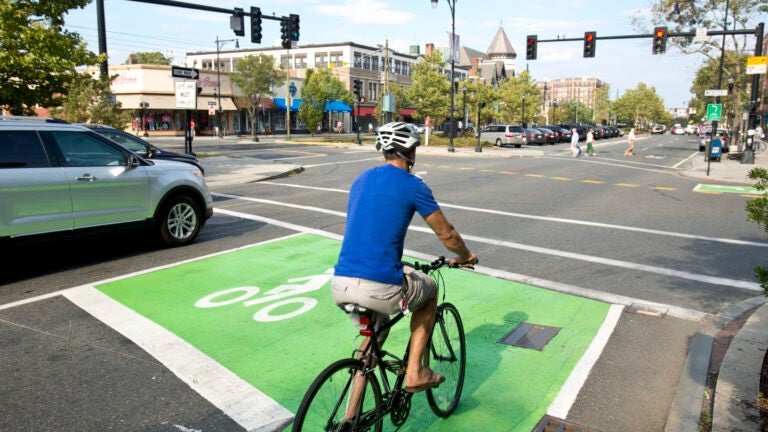
At the State House this week, Massachusetts lawmakers moved forward with a proposal to encourage cities and towns to participate in a “Complete Streets’’ grant program to redesign their streets in a way that makes them safer and more efficient for multiple modes of transportation.
Complete Streets is a safety program spearheaded by neighborhood advocacy coalition Smart Growth America. It encourages local governments and municipalities to accommodate safe access for all modes of transportation on roadways, including motor vehicles, pedestrians, cyclists, public transportation and delivery vehicles.
In a phone call with Boston.com, Democratic Rep. William Straus, the House Chair of the Joint Committee on Transportation, said when the legislature created the Complete Streets program in a 2014 transportation bond bill it added several requirements that likely deterred some communities from participating.
“The provisions of what we adopted two years ago included probably a little more complexity and bureaucracy than was needed,’’ said Straus.
For example, the original bill required cities and towns to protect Complete Streets elements when road work was underway, required private development proposals to ensure Complete Street elements are respected and created a 12-person committee appointed by the governor to develop by-laws for participating municipalities.
Straus said he worked with Transportation Secretary Stephanie Pollack and several safety groups to simplify the program.
New language requires municipal employees to receive training in the Complete Streets program and eliminates the 12-person committee. Instead, the Massachusetts Department of Transportation will rely on different advisory boards to oversee the program.
The program issues grants to approved projects that incorporate design elements that enhance mobility into a community’s infrastructure. This can include curb cuts on sidewalks for pedestrians and the mobility-impaired, dedicated bike lanes or strategically located crosswalks.
“There is no one design element that defines Complete Streets other than the concept that when you do design you have to keep in mind other transportation modes or users who may want to access the roadway,’’ said Straus.
Straus points out that Complete Streets designs are already in place, even without the help of state grant money. For example, MassDOT recently approved a $20.4 million project on Commonwealth Avenue between Boston and Brookline that will include building protected bike on the roadways.
The project will eliminate traditional bike lanes that allow bikes to travel between flowing traffic and parked cars. It will replace them with “cycle tracks,’’ a lane of parked cars that provides a barrier between cyclists and traffic.
The Commonwealth Avenue project will also widen sidewalks, install new streetlights and update ramps along the roadways to be compliant with the Americans with Disabilities Act.
Smart Growth America named seven Massachusetts communities, including Longmeadow and Weymouth, to its list of the best Complete Streets policies implemented during 2015.
Meanwhile, Massachusetts lawmakers also moved forward this week with several proposals aimed at improving transportation in the commonwealth. The measures include authorizing $750 million to be spent on highways and a $50 million program aimed at improving smaller bridges across the state over the next five years.




To comment, please create a screen name in your profile
To comment, please verify your email address
Conversation
This discussion has ended. Please join elsewhere on Boston.com