
New Parking Meters, More Bike Lanes, and Zero Traffic Deaths in Boston
Mayor Walsh lays out a vision for the future of cars in the city
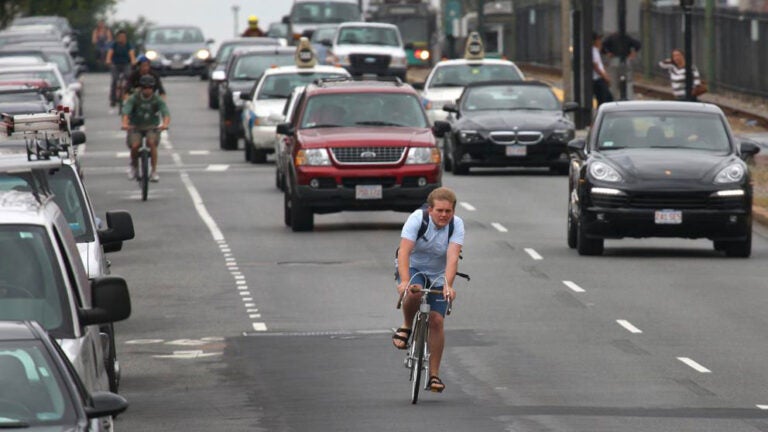
On Wednesday, Mayor Marty Walsh unveiled a number of reforms as part of the Go Boston 2030 initiative, which aims to map out the future of transportation in the city.
The goal of the reforms is to make “our streets safer, more accessible and more considerate of the different modes of transportation we have in Boston,’’ Walsh said at a City Hall news conference.
Here’s a breakdown of what drivers can expect.
Cars will share the streets with more bikes.
A section of Commonwealth Avenue will be the first major testing ground for the goal of accommodating multiple modes of transportation, as the city plans to install 6-foot-6-inch protected bike lanes. A 3-foot-wide curb will separate bikers from drivers on the piece of Commonwealth Avenue between the BU Bridge and Packard’s Corner.
“Bicyclists have the same rights to be able to ride on the streets and roads as anyone else does,’’ Walsh said. He also cited reports from other cities that indicated bike lanes increased retail activity at the businesses they pass.
Mayor Walsh said the redesign could also serve to slow down drivers, making everyone safer. Seventy-three parking spaces will disappear to make way for the new bike lanes, which should be completed by the fall of 2017.
City Councilor Michael Flaherty has already raised concerns about the loss of revenue-generating parking spots, according the Associated Press.
There will be better parking meters.

Coin-fed meters will be replaced by meters that accept credit cards and collect data for the city.
Coin-fed meters will soon be quaint relics in Boston. The city aims to replace them with smart meters that accept credit cards and smartphone payments. The city began a pilot program of the smartphone-based Park Boston in Back Bay in January, but today’s announcement applies to the entire city.
For now, more payment options are the only benefit drivers are likely to see. But the city is also keen to collect as much data as possible about people’s parking habits from the smart meters, which could lead to better management down the line.
Kristopher Carter, the director of programming in the Mayor’s Office of New Urban Mechanics, said it’s possible the city will open up the smart meter system to outside developers who want to create apps that, for example, would let drivers see which parking spots are empty near their destination.
Officials also didn’t rule out a system like the one currently in San Francisco, where the price of a spot rises and falls to align with parking demand in the area.
Cars in violation of street cleaning laws will not be towed.

Cars that fail to move for street cleaning will be ticketed, not towed, under a new pilot program proposed by the mayor.
Absent-minded drivers will no longer find their cars missing if they forget to move for street cleaning day — at least in one neighborhood.
Walsh says he’s drafting a City Council ordinance to create a pilot program in a yet-to-be determined neighborhood that will slap cars in the way of street sweepers with bigger tickets instead of towing them. The ordinance would raise the price of ticket from $40 to $90.
At the moment, the city often uses private towing contractors and collects only a portion of the penalty fee the towing companies charge drivers, Walsh said.
Maybe more speeding tickets?

Protestors lined Cambridge Street near the I-90 entrance in Allston last summer.
The mayor announced Boston will adopt the Vision Zero Initiative, a comprehensive way of thinking about road safety pioneered in Sweden and adopted by other U.S. cities like New York and Chicago.
The goal is to completely eliminate traffic deaths.
Walsh took the first step by creating a multi-agency task force to find areas of possible improvement in Boston.
“We need to look at how people share roads – drivers, bikers, especially pedestrians,’’ Walsh said. Some early areas of focus includes identifying areas with high crash rates, improving the Police Department’s electronic crash reporting system, and educating people on safe road behavior.
Officials did not elaborate on how Vision Zero could impact drivers in the long run, but the recent rollout in New York led to lower speed limits and a big spike in speeding tickets.
Correction: A previous caption referred to a “car lane’’ on Commonwealth Avenue, implying the lane was off-limits to bicyclists. Bicyclists are permitted to ride on all public roads in Massachusetts except limited acces or express state highways.




To comment, please create a screen name in your profile
To comment, please verify your email address
Conversation
This discussion has ended. Please join elsewhere on Boston.com