
In the ‘80s You Could Take a Helicopter to Work From Logan
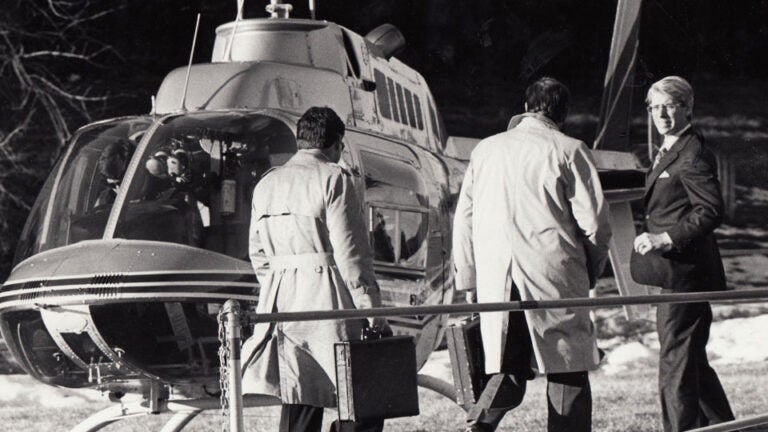
In 1986, the United States celebrated Martin Luther King Jr. Day for the first time, Halley’s Comet made a one-in-75 year appearance, and the traffic in Boston was so bad a lawyer named Rhett Flater looked to the skies for a solution.
Flater, a retired marine aviator who served in the Vietnam War, said he thought Boston transportation was lacking something: a quick way to get from Logan International airport to any of the booming tech companies, that were popping up along Route 128, like Hewlett-Packard, Polaroid, or Raytheon.
‘’It’s been said that because of the traffic delays in Boston, it takes longer to drive to Logan than it takes to fly from Logan to New York,’’ Flater told The New York Times in 1989.
So Flater and some business investors hatched a plan for HubExpress, a helicopter commuter service that would get business travelers from Logan to certain businesses in Greater Boston in a fraction of the time it would take them to drive.
“We could reduce a three-day business trip to a two-day trip,’’ Flater told Boston.com. “It was unique at the time. There wasn’t anybody else doing that.’’
HubExpress billed itself as “the only federally registered helicopter commuter service in the nation,’’ and at the height of its operation, its helicopters shuttled over 26,035 passengers from the main terminal in East Boston to six heliports in a year.
Unlike charter helicopter services, HubExpress ran on a regular hourly schedule and offered special package deals in conjunction with roughly a dozen other airlines, Flater said.
The company, headquartered in Stow, owned one helicopter, a Bell 206 single-engine helicopter, and leased three others. The rides took anywhere from six minutes (to Waltham) to 25 minutes (to Boxborough), and in 1989, cost $44 to $54 per passenger, depending on the destination. If helicopter flights were booked in conjunction with full fares on certain airlines, such as American, United, or TWA, commuters could use HubExpress either for free or at a reduced price.
The connecting heliports were located in downtown Boston, Boxborough, Waltham, Burlington, Norwood and Cambridge, Flater said, near large companies like Raytheon, G.T.E., Polaroid, and Hewlett-Packard. The management consultancy Arthur D. Little Inc. in Cambridge installed a heliport, as did the New England Executive Park in Burlington. A Hyatt Regency hotel in Cambridge even installed its own heliport on the roof of a parking garage, but the Cambridge ZBA found that it didn’t comply with local zoning codes, forcing the hotel to close the heliport in 1988.
Despite minor setbacks, Flater said business grew steadily from 1986 to 1991. In 1988, HubExpress had 6,756 passengers, and in 1989 there were 12,057. Flater said the growth proved HubExpress was serving a real need for travelers leaving Logan airport.
Before the Big Dig, rush hour traffic in Boston could be somewhat of a nightmare, with congestion in the Central Artery slowing traffic to a 14-hour daily crawl.
The Big Dig began in 1991 and lasted until around 2007, replacing Boston’s six-lane elevated Central Artery (I-93) that ran through the center of downtown with an underground eight- to ten-lane highway. It added two new bridges over the Charles River and extended I-90 to Logan International Airport.
Flater believed that though the project was supposed to improve Boston’s traffic congestion in the long run, traffic would only get worse while construction went on, expanding the need for HubExpress’s operations.
But in July 1990, a recession hit.
From 1990 to 1991, the U.S. faced a recession caused by a breakdown in the real estate market, the Gulf War, higher taxes, increased oil prices, and an unstable stock market, according to Forbes.com. Unemployment rose to 6.8 percent, and Flater said HubExpress saw a steep drop off in business travelers.
“The number of passengers flying in and out of Logan declined dramatically in the Recession and first Gulf War — from 30 to 15 million,’’ Flater said. HubExpress shut its doors in January 1991.
Flater said the decision to close HubExpress was difficult, but he remembers the “one-of-a-kind’’ service fondly. “We had essentially no competition, except rental car agencies and taxis,’’ Flater added.
With the passage of time, Flater said he no longer has access to HubExpress’s financial documents. But he did recall that HubExpress never achieved a profit, “though it nearly achieved break-even in 1990,’’ he said.
Would something like HubExpress work now?
With an unrelenting winter that dropped record-breaking amounts of snow, handicapped the T service and impaired Boston roadways, many might be tempted to say, ‘Yes.’
But those who remember HubExpress, like Boston College graduates Brian Harrington and Kevin Olivieri who created a marketing campaign for the helicopter commuter service for a business class in 1989, said it wouldn’t have the same market today.
Harrington is currently chief marketing officer at Zipcar, while Olivieri is chief tech officer at advertising agency Allen & Gerritsen in Boston.
“You have Uber and all these other driving services now, and with mobile phones, you can change your mind with what to do on a whim,’’ Olivieri said, adding that public transportation and major traffic arteries have been greatly improved in the past few decades as well.


To comment, please create a screen name in your profile
To comment, please verify your email address
Conversation
This discussion has ended. Please join elsewhere on Boston.com