
Sign up for the Today newsletter
Get everything you need to know to start your day, delivered right to your inbox every morning.
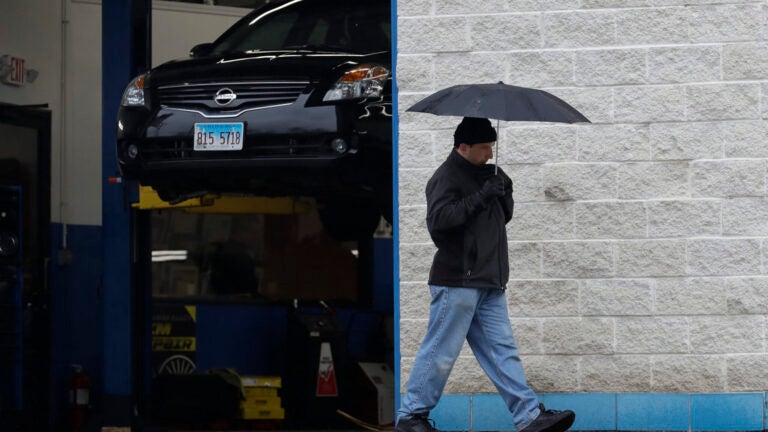
Q. As an elderly female, I have sometimes been overcharged and/or sold services I later found I did not need. A recent bill struck me as higher than expected. When a tire shop broke one wheel stud on my 2012 Nissan Sentra when swapping on snow tires recently, it caused the loss of multiple lug nuts and a scary ride on the interstate. After being towed to my auto shop, my repair bill for parts was $31.59 (one wheel stud, $3.99 and 4 lug nuts, $27.60). But labor was $154 for 1.40 hours, which included a road test for noise. With a total cost of $187.56, I’m confused. This is a trusted shop for most labor costs (parts are high), but is 1.40 hours to be expected for this type of repair?
A. Your regular repair shop treated you fairly. The repair takes 1.6 hours to complete. The repair requires removal of the wheel hub to install the new wheel stud. So, the labor charge was correct. To me it also seems that the tire shop should have some responsibility for all of this. Even though one of the lugs broke when putting on the snow tires, the other four lugs should have held the wheel safety until the car was repaired. From your description it sounds as if the tire shop did not fully tighten the wheel.
Q. I have a 2010 Volvo XC90 with 194,000 miles. The car was running great on a highway trip when I got a P0011 code on the highway and noticed a loss in acceleration. I went to my mechanic who suggested I check my oil level first before I start to replace the camshaft oil control valves. His reasoning is that the valves all run on oil pressure, and if the oil is low or dirty, this could cause a P0011 code. The oil level was fine but I was due an oil change, so I changed the oil, cleaned all the camshaft oil control valves, and checked for any frayed wires to the connectors. After about 175 miles the P0011 code came back on. My mechanic suggested I replace the control valves. After the repair the car ran fine, no problems. Then after about 300 miles I got a P0013 code, which indicates a variable valve timing component. Again my mechanic suggested cleaning the camshaft timing actuator sensors, which are also motor oil sensitive. After 200 miles, the P0013 code came back on. The car was running fine and I didn’t notice any difficulty in performance. We replaced the camshaft timing actuators. The car ran great. Now I just got a P0016 code that might be a worn timing chain or misaligned camshaft adjustment and the P0011 code came back on too. The car runs great. Now I’m looking at a new timing chain or adjustment. That looks like a big job. Since the car runs great, there are no accumulation problems. I’m wondering if a new timing chain will correct all these related codes.
A. The P0011 code leads me to the timing chain, but if cleaning and replacing solenoids did not work, it is more than likely the VVT (variable valve timing) units. The P0013 could be timing related, but also could be an open or short in the ECM to VVT solenoid. I would also do a very close visual inspection of the wiring. I have seen multiple cases of wiring damage caused by rodents lately. There is no easy answer to this one. At this point a technician with a scope may be able to check the timing-the issue as this all has to do with the synchronizing of the crankshafts and camshafts (which could be a loose timing chain).
Q. I have a problem with my BMW M3. It has 190,000 miles and is still great to drive. However, for the past five years or so the warning light has come on with codes to engine misfire for cylinders 1, 4, or 5. The cylinder identified varies. Actually, there is no misfire that can be felt or detected, and the car runs beautifully. I have had the spark plugs and coil packs changed and the codes cleared. Bottom line: Sooner or later the light comes on and I can’t pass inspection until the computer is “ready”. This takes longer and longer. It used to be 50 miles, then 100, lately even 150 miles is not enough driving. I love this car; I’ve had it since new. I’m retired and don’t want to buy a new car. Any ideas?
A. I suspect there is some sort of vacuum leak causing a random lean misfire. This could be due to deteriorated vacuum hoses, or a leaking intake manifold. At this point the best thing to do would have a “smoke” test performed. In this test a technician pumps synthetic smoke into the engine and looks for where the smoke is escaping. The other possibility is there is an excessive amount of carbon build up on the valves and they are not closing fully which can also cause a misfire. This carbon can sometimes be cleaned chemically and even with a type of sandblasting using walnut shells.
Q. While driving my 2005 Toyota Highlander, the check engine light came on and the VSC light and the Trac off light came on. I thought it might be a dirty wheel ABS sensor, since I have never touched the sensors in 17 years. I took it to a local auto parts store, and they came with a code P0138 which is the downstream oxygen sensor 504. The sensors go from $20 up to $200 plus for the part. Since I will drive my car another 15 years, should I pay more for a good sensor? Also, I am a little puzzled about the dash lights. If it is an O2 sensor, why do the VSC and Trac off lights come on?
A. When it comes to engine management sensors it is best to use a quality part. I have seen some of the $20 sensors cause drivability issues. I would purchase a sensor that is better quality such as Bosch, Denso, or NTK (the manufacturer of the original part and my choice). Regarding the VSC and TRAC lights, I have seen some cars that when there is a drivability issue, the traction control and ABS brake system shut down. At this point I would treat each code as a separate issue. If once the emissions code is repaired and if the VSC/TRAC lights are still illuminated, there is likely a cracked tone ring or excessive rust affecting the ABS/VSC/TRAC system.
John Paul is AAA Northeast’s Car Doctor. He has over 40 years of experience in the automotive business and is an ASE-certified master technician. E-mail your Car Doctor question to [email protected]. Listen to the Car Doctor podcast at johnfpaul.podbean.com.
Get everything you need to know to start your day, delivered right to your inbox every morning.





To comment, please create a screen name in your profile
To comment, please verify your email address
Conversation
This discussion has ended. Please join elsewhere on Boston.com