
Newsletter Signup
Stay up to date on all the latest news from Boston.com
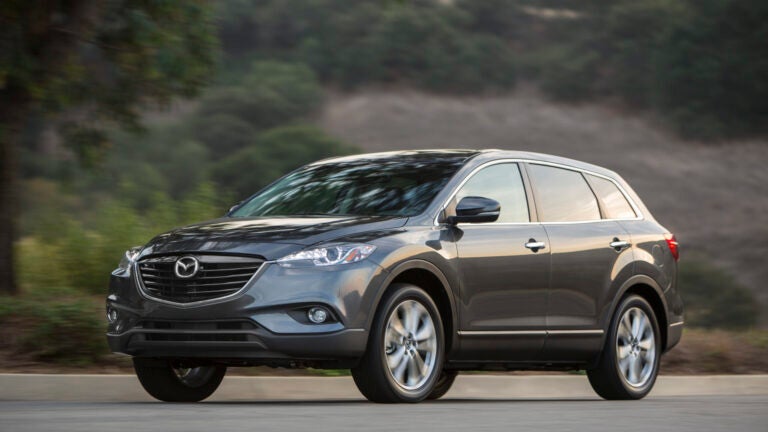
Q. My 2014 Mazda CX-9 has 63,000 miles and I faithfully change the full synthetic 5W-20 oil and filter every six months. I never reach 5,000 miles during the six months or I would change it at that mileage. I use “regular” synthetic oil. I’m reading that it might be time for the “high mileage” engine oil version. Supposedly it has additives for aging seals. The Ford 3.7L V-6 Duratec in this SUV is dynamite. No oil leaks and I love its performance. What are your thoughts on switching to the high mileage? Also, I am starting to look at the CX-9’s replacement, the 2024 CX-90. Mazda has replaced the recent four-cylinder turbo engine with a six-cylinder engine in 2024. Since it is the first year for this engine, I am watching for feedback. Have you heard any?
A. At first, I thought high mileage oil was just marketing, but after some research it does have its benefits. It will help with aging engine seals. The additives condition the seals and don’t swell them up like some pour-in additives do. That being said, at 10 years old and using good oil, I’m not sure you need it. Perhaps switch in the 75,000 to 100,000-mile range. The only negative of high-mileage oil is it costs a bit more. As for the latest CX-90, a very well-made vehicle and the new six-cylinder engine performed quite well during my road testing. There are a couple of powertrain choices – plug in hybrid, mild hybrid, and conventional engine. The mild hybrid and PHEV are too new to know how they will do. The conventional inline six-cylinder turbo engine, also new for Mazda, seems very solid. The interior is very comfortable and unlike many bigger SUVs, handling is quite good. The newest Mazda is not without some problems, with at least two recalls since its introduction.
Q. My son is visiting from overseas and borrowed my car to drive to Pittsburgh to visit friends. The car is a 2012 Audi A4 with 90,000 miles and no significant issues to date, though it has been burning a bit more oil recently. The check engine light came on in Pittsburgh. The light is solid – no noticeable issues with driving yet. He did find a parts store and they came up with codes P2187 and P2279. Am I taking major risks allowing him to drive back home, provided there are no noticeable performance issues, and the light is not flashing? I would of course take the car in for diagnosis to my local trusted mechanic once he is back.
A. The two codes relate to fuel mixture, perhaps a leak in the air intake before the throttle plate, vacuum leak at the intake manifold, or even a dried out vacuum hose. The most common issue is with the PCV system, sometimes called an oil separator in VW/Audi engines. This could also explain your engines’ increased oil use. Since the car is running normally, chances are it is a minor fuel issue and should be okay. In the worst case, there could be some stalling.
Q. Ford continues to innovate in its quest to make trailering easier and less intimidating for truck owners through its Pro Trailer Assist, and in the past year, the ability to automatically hitch your truck to a trailer hitch. While these systems are available on the F-150, SuperDuty trucks, and Expedition, I have been following every year for when they would expand these options to the Explorer or Escape. Any rumors that this could happen soon?
A. I asked that question about a year or two ago with engineers from Ford and they said it was in the plans with the next major upgrades to the Explorer but not likely in the Escape. They hinted at that time that budgetary concerns were an issue, focusing more on electric vehicle development.
Q. I am wondering if you can recommend a good steering wheel lock and seat belt lock to protect my 2019 Honda CR-V. The rash of car thefts has me concerned, so I thought a lock of this type would be an effective way to deter auto thefts. It is easy to use and will not mar any of the surfaces like a bar type of lock would. I have read some of the reviews of this type of lock. My main concern is that I could install it and then cannot get it to unlock, or it could damage the seat belt receptacle, so it will not work either. I have read complaints about both conditions. The other one is the seat belt could be damaged and so the belt alert continues to chime. What do you think?
A. Like all of these devices (cane locks, steering wheel locks, and armored ignitions), they are a deterrent, and hopefully a thief would see this and move on. The weakness in this product is the seat belt. The device that I have seen has a rigid plastic case and strong cable, but it still connects to a fabric seat belt. Keep in mind that even the steel cable can be cut with a battery grinder or hydraulic cutters. Adding additional security is a personal choice and certainly could work, but I would also follow the advice of the police – park in well-lit areas, remove valuables, and lock the car.
John Paul is AAA Northeast’s Car Doctor. He has over 40 years of experience in the automotive business and is an ASE-certified master technician. E-mail your Car Doctor question to [email protected]. Listen to the Car Doctor podcast at johnfpaul.podbean.com.
Stay up to date on all the latest news from Boston.com




To comment, please create a screen name in your profile
To comment, please verify your email address
Conversation
This discussion has ended. Please join elsewhere on Boston.com