Cars lose the spare tire for a leaner ride, but it could cost you
Nearly a third of the 2017 model cars offered in the U.S. do not come outfitted with a save-the-day spare as standard equipment, according to a recent study by AAA.
To the list of items you should no longer expect to see in a new car — those once-common features like a metal ignition key, an ashtray or a vent window that swings open — you may soon be adding the spare tire.
Already, nearly a third of the 2017 models offered in the United States do not come outfitted with a save-the-day spare as standard equipment, according to a recent study by AAA.
In truth, the extinction of the spare tire has been happening, if gradually, for years. Full-size spares gave way to the space-saving “doughnut” versions you sometimes spot on vehicles traveling at worrying speeds. They, in turn, are yielding their under-floor real estate to no tire at all.
The elimination of the spare by automakers is not entirely an abandonment of good sense or a severe example of cost-cutting; in fact, it can benefit drivers. The primary goal is weight reduction, a crucial factor in meeting fuel economy standards.
Removing a substantial amount of rubber and steel — up to 40 pounds, according to industry experts — along with a jack and a lug wrench is a big win for engineers who are conditioned to shave ounces wherever possible. But as appealing as it may be to skip the doughnut and lose a little weight, the disappearing spare can cause headaches: AAA said that last year it had answered roadside assistance calls from 450,000 members whose cars did not have spares — a situation that can mean a trip to the repair shop on a flatbed.
The freedom to eliminate spare tires altogether is largely possible as a result of developments in tire construction technology.
An increasingly popular alternative to spares is the so-called run-flat design, which most new BMW models use. Intended to make roadside tire changes unnecessary, this solution employs a reinforced tire sidewall that typically lets the driver continue for 50 miles at up to 50 mph after air pressure is lost. But they can be more costly: It may be necessary to replace, rather than simply patch, a damaged tire, and replacements are typically priced $25 to $50 higher than a conventional design.
Another alternative is the self-sealing tire, an older solution reappearing in modern form on the battery-powered Chevrolet Bolt, where reduced weight translates to more miles per charge. Designed solely as an electric vehicle, the Bolt has no provision for carrying a spare. According to Michelin, which supplies the Bolt’s Energy Saver A/S Selfseal rubber, the extra cost of a self-sealing tire — which can continue down the road even with a nail in the tread — is about $33 compared with conventional tires of the same size.
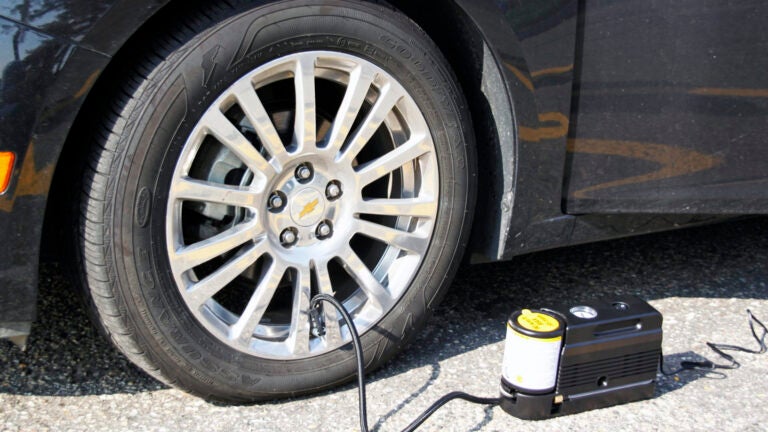
But some models are losing the spare without the benefit of run-flat or self-sealing rubber, instead including conventional tires and a leak repair kit — packaged in an aerosol can or used in conjunction with a small air compressor powered by the car’s battery.
Such kits skim weight while skipping the tire, but have limited abilities to deal with any road hazard more serious than a nail hole in the tire’s tread section. A larger tear in the tire — something that can happen when modern low-profile tires meet a pothole — or damage to the sidewall or wheel rim will not be fixed by a leak kit. The sealants, which are usually one-time use devices, have a finite shelf life — usually from four to eight years, AAA said — and cost about $40 to replace.
In some cases, greater peace of mind is available from the automakers.
For instance, although mainstream versions of the 2017 Honda Civic come from the factory with space-saver spares, the Civic Si does not. A spare wheel kit, including a jack and tools, is available from Honda dealers as an accessory for the Civic Si at a suggested retail price of $254. The tire, which must be purchased separately, runs about $115 from sources like Tirerack.com.
BMW offers a compact spare kit — including jack and wrench — for many of its X-Series sport utility vehicles and for the 5- and 7-Series sedans. In most cases, it’s a $150 option when ordering the car, though on some models with conventional tires it is free. On the sport utility models, the compact spare fits entirely within a compartment under the rear floor, but on the sedans it juts out too high, meaning the floor panel cannot lie flat.
Not surprisingly, independent online retailers have also emerged to fill the hole. Buyers should make sure to compare prices with the dealership and to determine that there is a storage spot in the car where the tire can be secured. As designers work to smooth airflow under the car for fuel-economy improvements, those compartments are going away, too.
The disappearance of the spare tire might be more than just an exercise in efficiency. It may be a sociological statement. A survey by AAA found that some 20 percent of drivers do not know how to change a flat tire, and with the rise of roadside assistance coverage for new cars, that number is unlikely to shrink.