
Auto Q&A: Take your ‘check engine’ light seriously
There can be literally a hundred possible reasons for an illuminated check engine/service engine soon light.
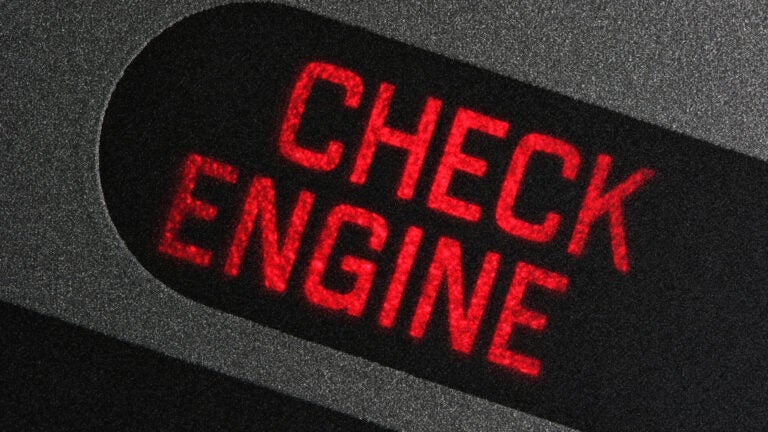
Q. When a “check engine” light comes on, how serious can this be? Should I stop driving, get it fixed the next day, or when it’s good for me? Everyone tells me something different.— KenA. There can be literally a hundred possible reasons for an illuminated check engine/service engine soon light. This indicates a fault has been recognized that will likely increase exhaust or fuel tank emissions beyond an allowable point. Some faults are more serious than others. If the engine runs smoothly with no noticeable issues, and the transmission shifts correctly, check it within a week or less. If noticeable engine or transmission issues are present, look into it today or tomorrow morning, especially if there is thumping/power loss. And if the lamp flashes, try to stop driving right away or change the driving type so the flashing changes back to steady. Continuing to drive will possibly trash the expensive catalytic converter.Q. I was washing my car and noticed there are little red and yellow dots on my new tires. I remember reading quite a while back that one of them is supposed to line up with the filler? I thought I’d ask before saying something to the tire store.— JenA. Some tire manufacturers mark their tires with small colored paint dots to aid in the best installation/balancing process. As well made as tires and wheels may be, there can be minor variations in tire weight around its circumference, tire rolling resistance, wheel weight, and radial run-out.Yellow and red dots allow two methods of match-mounting the new tire to a wheel. A yellow dot indicates the point of lightest weight of the tire. When there are no manufacturer marks on the wheel indicating the point of minimum radial run-out, the yellow dot should be aligned with the wheel’s valve stem, the wheel’s heaviest point. This is referred to as the weight method.If a wheel is marked as described above, with perhaps a dimple or dot, the red tire dot should be aligned with it. This matches the tire’s greatest radial run-out with the wheel’s least radial run-out. This is called the uniformity method and is preferred, if possible.There are a few flies in the ointment with this process. The valve stem of an aluminum wheel isn’t necessarily the wheel’s heaviest point (as it was on steel wheels). Additionally, as a wheel bumps and thumps along throughout its life, its point of radial run-out may change. These can make the position of the dots perhaps of little or no consequence.There is a tire balancing process many shops employ using a Hunter Road Force Balancer where the machine feels the tire using a loaded roller as it is spun. This senses variations in tire rolling resistance and uniformity. These are factored into the balancing and tire/wheel matching processes, resulting in the smoothest possible ride. In some cases, the tire may be dismounted and rotated on the wheel for the best match, again making the position of the colored dots moot.A competent tire installer should also check for damage to or a possible bent wheel, dirt buildup on the tire/wheel sealing surface, use proper lubrication on the tire bead prior to installation, insure the bead seats fully and uniformly, insure the wheel seats correctly on the hub, and tighten the lug nuts are correctly.Winter tires make a difference in snowy climesBy Bob Weber, Chicago TribuneQ. I purchased a 2019 Golf R, and everyone is telling me I’ll need another set of wheels and tires for the winter. They are telling me that my specific tire is designed to be a “summer” tire. They are low-profile Continental tires that are currently on the car. Do I really need to do this?–P.P., ChicagoA. According to the experts at Tire Rack, it is wise to install winter tires on your car if you live in the Snow Belt. All-season tires are OK if you live in the South and seldom see snow. Summer performance tires won’t cut it. Chicago sees an abundance of the white stuff, so, yes, we suggest winter tires. A set of winter tires may last for about six seasons and having them already mounted and balanced saves time and money every year you swap them. We recently drove identical cars on the Notre Dame hockey rink ice, and the difference in control and stopping was dramatic between all season and winter tires. Short answer: Get four winter tires.Q. I grew up in the early 1940s when all cars were controlled mechanically. In the mid-1970s, Chrysler started using computers and sensors. Then everybody else jumped on board. Now everything is controlled by the cars’ computers: brakes, engine, seats, windows, climate, mirrors, stability, etc. When this electronic stuff starts failing, what is a person supposed to do? I drive three GM cars — 1998, 2000, and 2004. My oldest car needs a Steering Wheel Position Sensor; I get a constant warning on the DIC.–J.B., Lauderdale Lakes, Fla.A. It may be a small consolation, but electronic controls are more reliable and durable than the mechanical stuff. For instance, the electronically controlled windows’ motors are more likely to fail than the electronics. Sure, sensors fail, but they are usually easily replaced.Q. I volunteer at the Chicago Botanic Gardens. Four times this year so far, I found when I tried to start my car to go home my key fob did not work. I had to open the fob to open the door with the key. Then the alarm goes off. The first time this happened I called my wife to bring the extra fob to help start the car. We tried the extra fob and it didn’t work. I called the Jeep Dealer and they said to start the car pressing the fob on the start button instead of your finger. Sure enough, the car started. One day while starting my volunteer assignment, I saw a garden guest sitting on a lawn with her Jeep fob in her hands. I asked if she has a problem starting her car. Sure enough, she did. I started her car with her fob pressed on the start button. Do you have any idea why this happens?–J.B. Northbrook, Ill.A. There are a number of receiving antennas around the vehicle. They get the signal from your key fob that you are approaching. The start button needs that signal for both starting and security tasks. Jeeps have the potential for problems if removable body sections are missing. Touching the start button with the fob ensures that the signal is received. This applies to weak key fob batteries, too.





To comment, please create a screen name in your profile
To comment, please verify your email address
Conversation
This discussion has ended. Please join elsewhere on Boston.com