Auto Q&A: Troubleshooting a speedometer problem
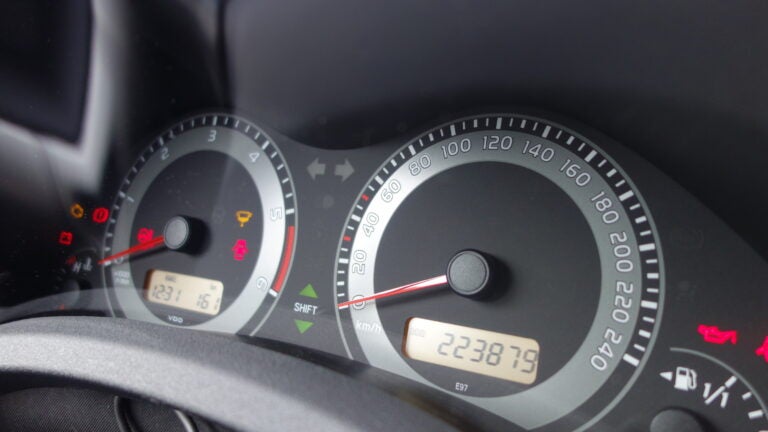
Q: I’m having a problem with intermittent readings on the speedometer of my 2000 Nissan Frontier. Sometimes it reads correctly or jumps around to different readings or no reading. There are no code readings stating bad speed sensor. Should I just replace the speed sensor or check other things first?— Clyde T.A: Your Frontier’s VSS (vehicle speed sensor) is a two-wire magnetic type signal generator which reports directly to the speedometer unit. The VSS signal is then shared with the PCM (powertrain control module) and is used for cruise control operation. It’s understandable there may not be an OBD-II diagnostic trouble code (likely would be a P0501) as the fault is intermittent.Have you tried checking to see if the fault affects cruise control operation? If an OBD-II generic scan tool is available, does it show consistent vehicle speed as the speedometer falters? My hope is the fault shows up everywhere, steering us towards the source of the signal.The Nissan test procedure for a suspect VSS of this type is to remove it from the transmission, unplug the two wire connector, and see if it outputs 1/2 volt AC or more as you spin it by hand. This isn’t going to help, as the fault is intermittent. Viewing the signal with a scope or graphing multimeter while driving is the best way to check, but there are easier/cheaper things to try.Wiggling/reseating the VSS connector, inspecting for frayed wires, and then checking for differing operation would be a productive diagnostic step. I’m typically not one to throw parts at a car, but with the cost of a replacement sensor being only $15 to $40 and it being easy to change, simply renewing it could be a big bang-for-the-buck diagnostic step.Worst case scenario: If replacing the VSS doesn’t help, removing the IPC (instrument panel cluster) and checking connections would be next. Renewing the speedometer would be the final straw, after verifying a solid VSS signal to it during an episode.
Q: My wife has a 2014 Forester Touring, 2.5 liter. I go to the same shop for oil changes and tire rotation. At 53,000 miles, they said the front brakes were down to 3/10 and the next time I should consider replacing. Next visit, at 58,000 miles, they said the fronts were still at 3/10 but now the rears were down to 3/10. Is this an eyeball measurement? Should I just take their word for it? Original brakes, so should I just replace them anyway?
— Paul
A: This seems a little odd because front disc brakes typically wear out around twice as fast as the rears do. The original friction material thickness on the Forester pads is 11mm in the front and either 9mm in the rear (or 11mm if equipped with ventilated rotors). The shop’s 3/10 description is possibly an eyeball guesstimate, or it could have been measured with a tool, and the 10 could be their estimate of the original thickness in mm, which is pretty close.
Subaru says a 1.5 millimeters is minimum pad thickness. I would have no problem changing them at 3mm to avoid the risk of an accidental metal-on-metal condition (inner and outer pads don’t always wear evenly).
The next questions is: Will this be a simple pad swapping or is rotor refinishing going to be necessary? I typically lean toward leaving rotors alone unless there’s a reason for refinishing such as thickness variations or surface imperfections. Ask also for your choices available for pad quality. I would spend a little extra for high-quality pads with a good blend of quiet operation, superior braking performance, and long life. A second opinion wouldn’t hurt.
Q: I have a 2015 Infinity Q70. I use premium gas. Do I have to? Is it recommended, or is it a marketing trick to pay more? I have always driven Infinitis and have paid for premium. They say an Infiniti will run forever if you change the oil regularly. I don’t need synthetic oil. Just regular oil is fine. Correct? But what’s the interval? I usually go to Jiffy Lube every 3,000 miles. Good practice?
— Joe in Chicago
A: Your Infiniti Q70 requires premium-grade fuel. Checking the filler neck/gas door for a label can confirm this. Many vehicles with high-performance engines require premium-grade fuel because of its higher octane, which mitigates detonation, a violent form of abnormal combustion. Significant pressure, heat, and stress occur when fuel explodes rather than burns in a controlled fashion.
Some car makers merely recommend premium fuel. In this case the engine’s requirements are not as high, and the management system is capable of tuning ignition timing and other functions to tolerate lesser-grade fuel. If driven under high temperatures or stressful conditions, such as climbing over a mountain pass during the heat of summer, I would absolutely go with the higher-grade recommended fuel. If a vehicle doesn’t specify premium fuel is needed, and there are no issues with pre-ignition or detonation, using it is a waste of money.
Regarding your oil change question, the Infiniti engine on your Q70 employs special friction reducing coatings on certain parts and a highly sophisticated valve train that benefit from using top-notch oil.
Nissan recommends their branded ($13-ish per quart) engine oil that contains an ester additive and some other high-tech friction reducing tricks. There is considerable debate on whether a good synthetic oil might do just as well at less cost. Infinity recommends changing oil on your Q70 every six months or 5,000 miles.
What really matters is your driving habits. Extreme cold weather operation, short run times, lots of idling in traffic at higher temperatures, demanding high temperature conditions/towing, and driving in dusty conditions bring down the recommended oil change interval possibly as low as 3,000 miles. Easier conditions and long run times could make a 8,000- to 10,000-mile oil change reasonable. I’m thinking: buy a five-quart jug of Mobil 1 extended performance synthetic oil for $30 or $35 and bring it to your shop every 5,000 to 6,000 miles.